

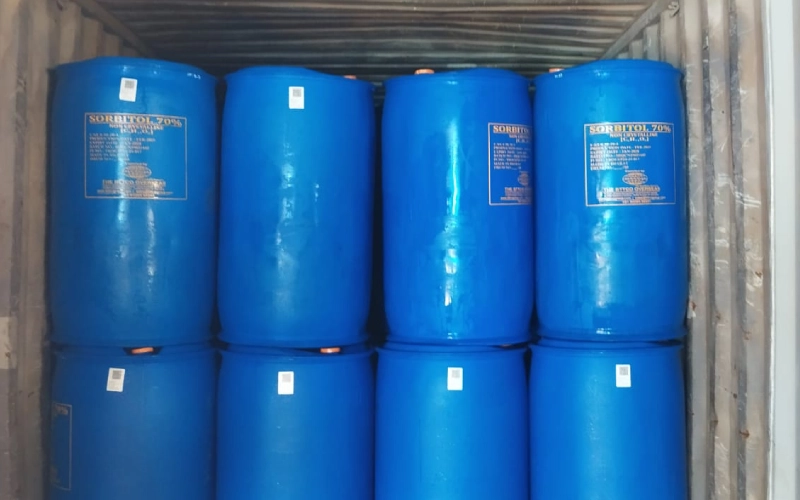
HSN Code – 29054400
CAS No – 50-70-4
Packaging – 300 Kilos Drums
Food Industry
Pharmaceuticals
Used in the formulation of syrups, lozenges, and chewable tablets.
Can act as a laxative (due to its ability to retain water in the intestines).
Cosmetics and Personal Care: As a humectant, it is found in moisturizers, lotions, and creams to help maintain skin hydration.
Oral Care: Found in toothpaste and mouthwash products, as it does not contribute to tooth decay, unlike regular sugar.
Medical Use: Sorbitol is sometimes used in certain medical solutions, like intravenous fluids, to treat dehydration.
Oral Care & Cosmetics: Toothpaste, Mouthwash, Creams, Ointments, Lotions, Shaving Creams & Shampoo
Pharmaceuticals: Liquid Syrups , Suspensions & Soft Gel Capsule
Food & Beverage: Candies, Energy drinks / Diet Chocolates, Biscuits Cakes & Pastries, Chewing Gums, Enzymes, Ice Creams, Fruit Jams & Halawa.
Industrial Applications: Vitamin ‘C’, Sorbitol Esters, Polyether Polyols for Rigid Polyurethane Foams, Alkyd Resins, Melamine & Phenolic Resins.
Others: Tobacco, Papers, Explosives, Mortars & Concrete.
Sorbitol is a sugar alcohol commonly used as a sweetener and humectant (moisture-retaining agent) in various food, cosmetic, and pharmaceutical products. It is a naturally occurring compound found in fruits like apples, pears, and peaches, but is often synthetically produced from glucose for industrial use.
As a hexahydric alcohol, Sorbitol is a member of the polyhydric alcohol family, the lowest of which are ethylene glycol and glycerol. The close chemical relationship between Sorbitol and the lower alcohols (like glycol and glycerol) is responsible for the similarity in their general physical properties and applications in industrial technology.
Sorbitol is soluble in water to approximately 83 parts Sorbitol in 100 parts of water by weight.Viscosity as well as specific gravity of Sorbitol 70% solution is higher than that of glycerin at the same concentration. Sorbitol is extremely useful as humectant. Because it is stable and non-volatile even with water vapour, there is no loss during heating or cooking or by evaporation. Unlike ethylene glycol, Sorbitol is non-toxic and non-irritant. The taste of Sorbitol is mild, sweet, cooling, and unobtrusive. Sorbitol is more resistant to bacteriological degradation than sugar. This resistance also makes it less vulnerable to mould growth than most other humectant plasticising material.
Sorbitol is chemically inert and compatible with many chemical substances. In general, the hexitols and particularly Sorbitol have the ability to chelate iron, copper and aluminium ions in aqueous solutions.
Sorbitol undergoes several chemical reactions like oxidation, reduction, esterification and etherification, yielding such important products as ascorbic acid (Vitamin C), Sorbitansorbides etc.
In general, hexitols and their derivatives particularly One of the major uses of Sorbitol is as a humectant and conditioning agent. Many products under day-to-day atmospheric changes require the addition of a humectant to assist them to retain their freshness, softness and flexibility and to maintain ideal manufacturing conditions.



Alibaba


Copyright © 2025 The BTTCO Overseas. All rights reserved.