

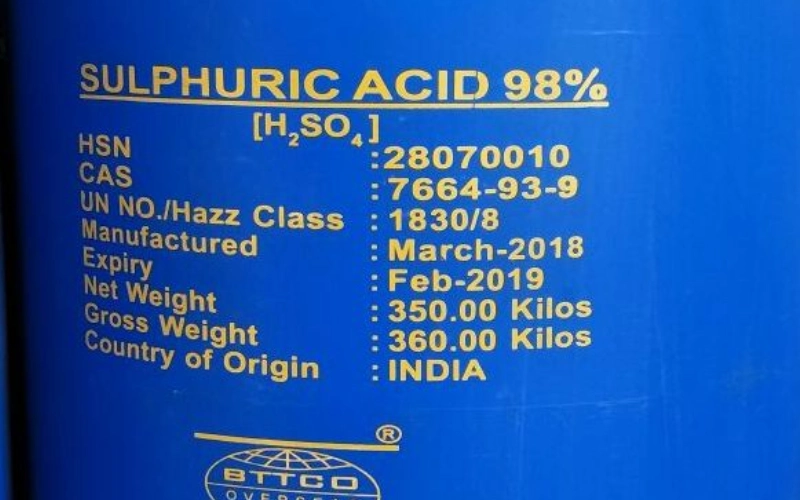
HSN Code – 28070010
CAS No – 7664-93-9
Packaging
Sulfuric acid is used in a variety of industries due to its highly reactive and versatile nature.
Fertilizer Production: Primarily used to produce phosphate fertilizers by reacting with phosphate rock to produce phosphoric acid.
Petroleum Refining: Employed to remove impurities like sulfur from crude oil during refining processes (hydrodesulfurization).
Chemical Manufacturing: It is involved in producing other chemicals, including hydrochloric acid, nitric acid, and synthetic detergents.
Acts as a catalyst in petroleum cracking and other organic synthesis reactions.
Battery Manufacturing: Sulfuric acid is the electrolyte used in lead-acid batteries (common in automobiles).
Metal Processing: Used for pickling (cleaning) metals, especially steel, by removing rust or scale.
Cleaning and Waste Treatment: It is used in various cleaning operations, including in the treatment of industrial waste streams.
pH Adjustment and Water Treatment: Sulfuric acid is employed to adjust the pH of water and wastewater in treatment plants.
Synthesis of Other Chemicals: It’s used to synthesize a wide variety of organic and inorganic chemicals.
Sulfuric acid(h2so4) has many uses in different industries, such as mineral processing, petroleum refining, fertilizer production, and wastewater processing.
Uses of sulphuric acid is to produced fertilizers, mainly ammonium phosphate, superphosphates, and ammonium sulfates.
Sulfuric acid is the iron manufacturing industry, it is used to remove oxidation.
Sulfuric acid has many applications like producing pigments, dyes, cleaning agents, detergents, explosives, and drugs.
In lead-acid batteries sulfuric acid is used as the electrolyte.
Major amount of sulfuric acid is used to produce phosphoric acid, calcium dihydrogen phosphate, phosphate fertilizers, and ammonium phosphates. It is also used to make ammonium sulfate, which is a particularly important fertilizer in sulfur-deficient.
Sulfuric acid is mostly used in metal processing in the production of copper and zinc. It also cleans the surface of the steel sheet, which is called pickling.
It is utilized to produce caprolactam, which is transformed into polyamide 6 and in the manufacture of titanium dioxide.
In many industries, Sulfuric acid is widely used to produce phenol and hydrofluoric acid with propanone.
In the household, it is used as a drain cleaner with other reactive property.
Many other industries use this chemical for, production of cleaning agents, wastewater processing, producing explosives, processing of minerals, paper industry, and detergents manufacturing.
In the skincare industry uses of sulphuric acid is to make skin ointments to heal skin infections like canker sores.
Other uses are batteries manufacturing, potato farming, detergents making like trisodium phosphate, perfume manufacturing, printing ink manufacturing.
Sulfuric acid (H₂SO₄) is a highly corrosive, dense, colorless liquid with a strong acidic nature. It is one of the most widely used industrial chemicals, and it plays a crucial role in various chemical processes.
Sulfuric acid (H2SO4) is a mineral acid made of oxygen, hydrogen, and sulfur. It is also called oil of vitriol, battery acid, acido sulfur, and hydrogen sulfate. It is the third most largely manufactured industrial chemical. It is an odorless, viscous and colorless liquid that is soluble in water.
Sulfuric acid is a salient commodity chemical, and for any nation, the productions of Sulfuric acid are a good sign of its industrial influence. It is a corrosive chemical for metals and tissue and it has an oily, glassy appearance.
Sulfuric acid can cause harm to the body if short-term exposure to high concentrations or Long term exposure to low concentrations from inhalation.
Uses of sulphuric acid are to produce fertilizers and other chemicals, in steel and iron production, and in petroleum refining.



Alibaba


Copyright © 2025 The BTTCO Overseas. All rights reserved.