Elevating Safety: Why Perimeter Safety Screens Are the New Standard for High-Rise Construction

The skyline of a modern city is a testament to human ambition and engineering prowess. However, as our buildings reach higher into the clouds, the logistical and safety challenges grow exponentially. In the high-stakes world of high-rise construction, the transition from traditional safety methods to advanced integrated systems isn’t just a trend it’s a necessity.
Based on the core principles of modern site management, let’s dive into why the Perimeter Safety Screen (PSS) is replacing traditional nets and barricades as the gold standard for protecting lives and investments.
The Evolution of Falling Protection
In the early days of vertical expansion, safety was often reactive. We relied on safety nets and temporary barricades. While these tools were revolutionary for their time, they possess inherent flaws that modern engineering has finally addressed.
The Limits of Safety Nets
As noted in industry observations, safety nets are far from foolproof.
- The “Bounce” Risk: A person falling from a high floor may be caught by a net, but the impact and subsequent rebound can still cause significant injury.
- Debris Containment: Nets are often designed for “few items,” such as deshuttering materials. Even then, they aren’t 100% effective. Small tools, bolts, or concrete shards can slip through the mesh or bounce outward, creating a “debris rain” that threatens workers below and the public on the street.
- Psychological Impact: Nets provide a “catch-all” safety net, but they don’t create a controlled, indoor-like environment. Workers are still exposed to high winds and the dizzying sight of the drop, which can impact productivity.
What is a Perimeter Safety Screen?
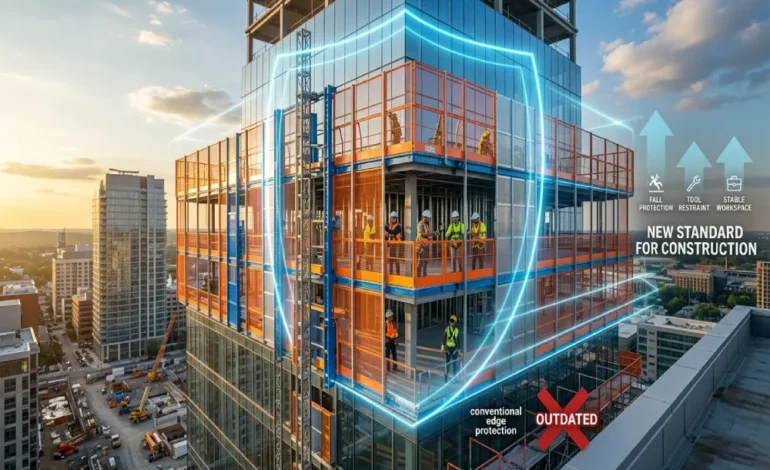
A Perimeter Safety Screen is a comprehensive, rail-climbing system that encapsulates the top working floors of a high-rise building. Unlike a net that sits below the work zone, the screen moves with the work zone. It creates a solid or micro-perforated wall that completely encloses the slab edge, effectively turning a high-altitude platform into a secure, indoor-like workspace.
The Pros: Why the Shift is Happening
1. Total Enclosure
The primary advantage of a PSS is the elimination of the “gap.” Because the screens are flush against the building and extend several floors high, there is virtually zero chance for a worker or a piece of equipment to fall to the ground.
2. Enhanced Productivity and Weather Protection
High-rise construction is often at the mercy of the elements. At 40 stories up, wind speeds are significantly higher than at ground level.
- Windbreak: Screens act as a massive windbreak, allowing cranes to operate and workers to move safely in conditions that would typically shut down a site using only nets.
- Privacy and Focus: By blocking the view of the sheer drop, screens reduce “height anxiety,” allowing workers to focus on their tasks with the same confidence they would have on the ground floor.
3. All-in-One Integration
Modern screens often integrate loading platforms and stair towers. This means workers don’t have to exit the protected zone to move materials or travel between the top three or four active floors.
The Cons: The Challenges of Implementation
While the PSS is superior in safety, it does come with hurdles that developers must navigate:
- Initial Complexity: The assembly and “jumping” (climbing) of the screens require specialized hydraulic systems and trained technicians.
- Weight and Load: The building’s structure must be able to support the weight of the screens and the wind loads they transfer to the floor slabs.
- Lead Times: Unlike buying a roll of safety netting, PSS systems are often custom-engineered for the specific geometry of the building, requiring longer lead times for design and fabrication.
The Bottom Line: Cost Impact and ROI
When looking at the balance sheet, many project managers initially baulk at the price tag of a Perimeter Safety Screen system compared to traditional barricading. However, a true Value Engineering approach reveals a different story.
| Factor | Traditional Nets/Barricades | Perimeter Safety Screens |
| Upfront Cost | Low | High (Rental + Hydraulic Setup) |
| Labor Cost | High (Constant manual moving/fixing) | Low (Automated hydraulic climbing) |
| Speed/Cycle Time | Slower (Weather delays + manual resets) | Faster (Consistent 4-7 day floor cycles) |
| Insurance Premiums | Standard | Potentially Lower (Reduced Risk Profile) |
| Legal/Compliance | High risk of fines for falling debris | Maximum compliance and public safety |
The “Hidden” Savings The cost impact of a PSS is often offset by the reduction in cycle time. If a safety screen allows a crew to pour a floor one day faster because they aren’t hampered by wind or safety resets, that saving cascades through the entire project schedule. On a 60-story tower, saving one day per floor equals two months of overhead, labor, and financing costs saved.
Final Thoughts
Safety is the most critical aspect of high-rise construction, and the risk rises with the height. While traditional methods served their purpose in the past, the Perimeter Safety Screen represents the future.
It transforms a high-risk environment into a controlled industrial space. By investing in a PSS, developers aren’t just buying a “fence”; they are buying insurance against accidents, a shield against the weather, and an engine for faster construction. In the vertical race, the safest way up is also the smartest way to build.