Why Adi Shankaracharya is a Must-Watch: A Plea for More Meaningful Cinema

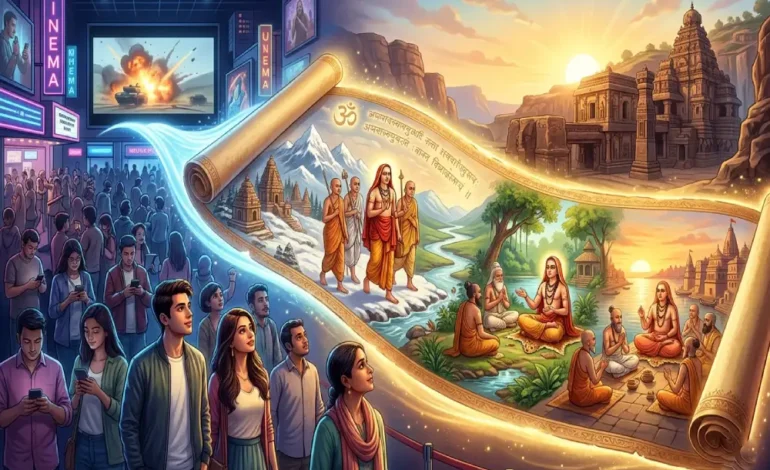
Cinema has always been more than just a source of entertainment for me; it is a mirror to our history and a window into the soul. However, as the years go by, I find myself increasingly asking: Where has the depth gone?
A few months ago, I stumbled upon a specific scene from a movie that stopped me in my tracks. It featured the renowned actor Nagarjuna, portrayed with immense gravitas as Lord Shiva. In this pivotal moment, he encounters Adi Shankaracharya, eventually breaking the legend’s ego and imparting a profound acknowledgment of truth.
The scene was so moving the music, the dialogue, the sheer direction that I immediately went to YouTube to find the full film. What I discovered wasn’t a modern blockbuster, but a masterpiece from the past. I was shocked and deeply moved. I can honestly say I have never seen such a fabulous, spiritually resonant movie about the legend of Shankaracharya.
The Spiritual Void in Modern Bollywood
While watching this “old” film, I couldn’t help but feel a sense of loss. It left me wondering: Why are these kinds of movies no longer being made, especially in Bollywood?
South Indian cinema has a rich, ongoing tradition of producing films that are not only high-quality but are also spiritually elevated and historically accurate. They aren’t afraid to dive into the lives of saints, philosophers, and the deep-rooted myths that define our culture. Yet, when we look at the current landscape of Bollywood, there is a glaring vacuum.
This leads to a difficult question: Is it that Bollywood directors are no longer capable of making such films? Or is it that they believe the audience simply doesn’t want them?
The Myth of “What the Audience Wants”
There is a common excuse in the industry that producers only create what the audience demands. I believe this is a fallacy. I think it is not always true that an audience’s wants are the only driving force behind production.
Cinema carries a weight of responsibility. It is the duty of the producer and the director to:
- Show what is good: Lead the audience toward quality rather than following the lowest common denominator.
- Show what is right: Uphold values that transcend temporary trends.
- Show what is history: Preserve the stories of our ancestors and legends for the next generation.
If South Indian cinema can successfully bridge the gap between faith, history, and modern filmmaking, why can’t Bollywood?
The Hunger for Substantial Content
The success of spiritual and historical epics in the south proves one thing: People want to see good things. We are hungry for stories that do more than just provide a two-hour distraction. We want cinema that makes us reflect on our existence, our heritage, and our ego—just as the portrayal of Lord Shiva challenged Shankaracharya.
We need to move away from the “masala” formula and return to our roots. We need filmmakers who are brave enough to believe that the public is ready for substance. The legend of Shankaracharya is just one of many stories waiting to be told with the respect and artistic brilliance it deserves.
A Call to Action for Filmmakers
It is time for a shift in perspective. We must demand more from our creators, and creators must demand more from themselves. Let us look back at classics like Adi Shankaracharya not just with nostalgia, but as a blueprint for what is possible when art serves a higher purpose.
The audience is ready. The question is: Is Bollywood?